The One-Page Messaging Fix for Your Business.
Notice that the title doesn’t say “if they don’t like it.” It says get it. Most businesses lose customers before anyone forms an opinion about them, good or bad, because the customer never understood what was being offered in the first place. If you’ve ever explained what you do in person and watched someone’s face light up, and then watched your website get nothing like that reaction, this is the problem.
This guide fixes it in two steps. First, a five-second test you can run today on anything you’ve published. Then seven questions, answered one at a time, that add up to your whole message on a single page, including the one sentence that says what you do.
Tell me your first name and where to send it, and the PDF opens right away.
Open it now and run the five-second test on page 6 before you change anything. A copy is on its way to your inbox too.
Here is the path the guide walks you down. None of it requires marketing experience. It requires honest answers, and the guide shows you what an honest, clear answer looks like at every step before asking for yours.
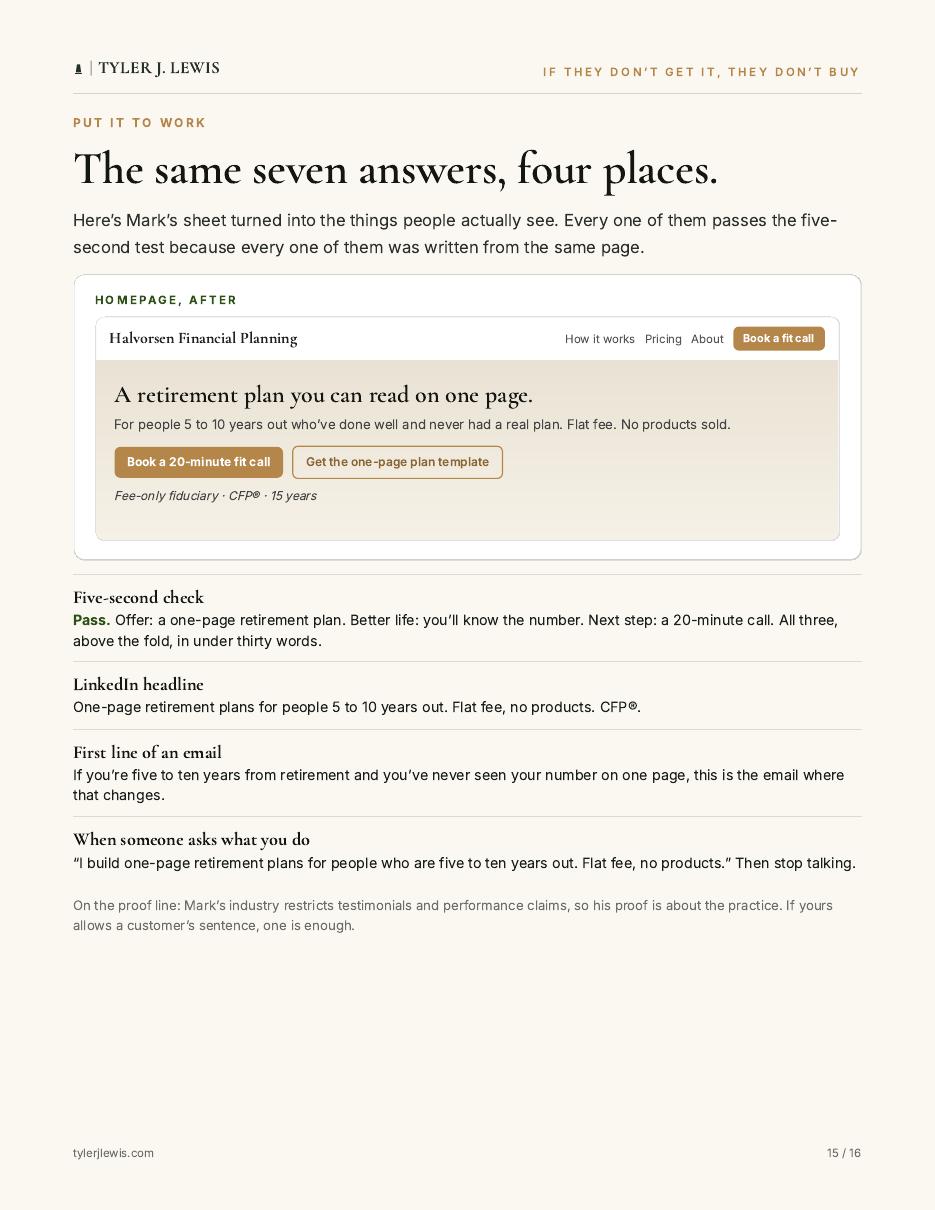
Show your homepage to someone who doesn’t know your business, and give them five seconds. Then ask them three things: What does this business offer? How would it make my life better? What am I supposed to do next? If they can’t answer all three, a real visitor wouldn’t either, and that’s where they leave.
The first three questions are about your customer, not you. You’ll pick one kind of person and describe them the way they’d describe themselves. You’ll write down what they’d say they want on a first phone call. And you’ll name the problem standing in their way, including how it feels to live with it, because that feeling is what they’re really hoping you can take away.
This is the center of the guide. You’ll write one sentence that says what you do, who you do it for, and what they get. It sounds simple, and it’s the hardest question of the seven, because you know too much about your own business. The guide shows you Dana’s weak sentence, her better one, and her clear one, so you can feel the difference before you write yours. If yours needs a second sentence to make sense, it isn’t finished yet.
The last three questions finish the story. One piece of proof that you can do what you say, and what counts as proof if your industry has rules about testimonials. One clear action you want them to take. And a picture of life after working with you, described as a specific moment they can see themselves in, not a list of benefits.
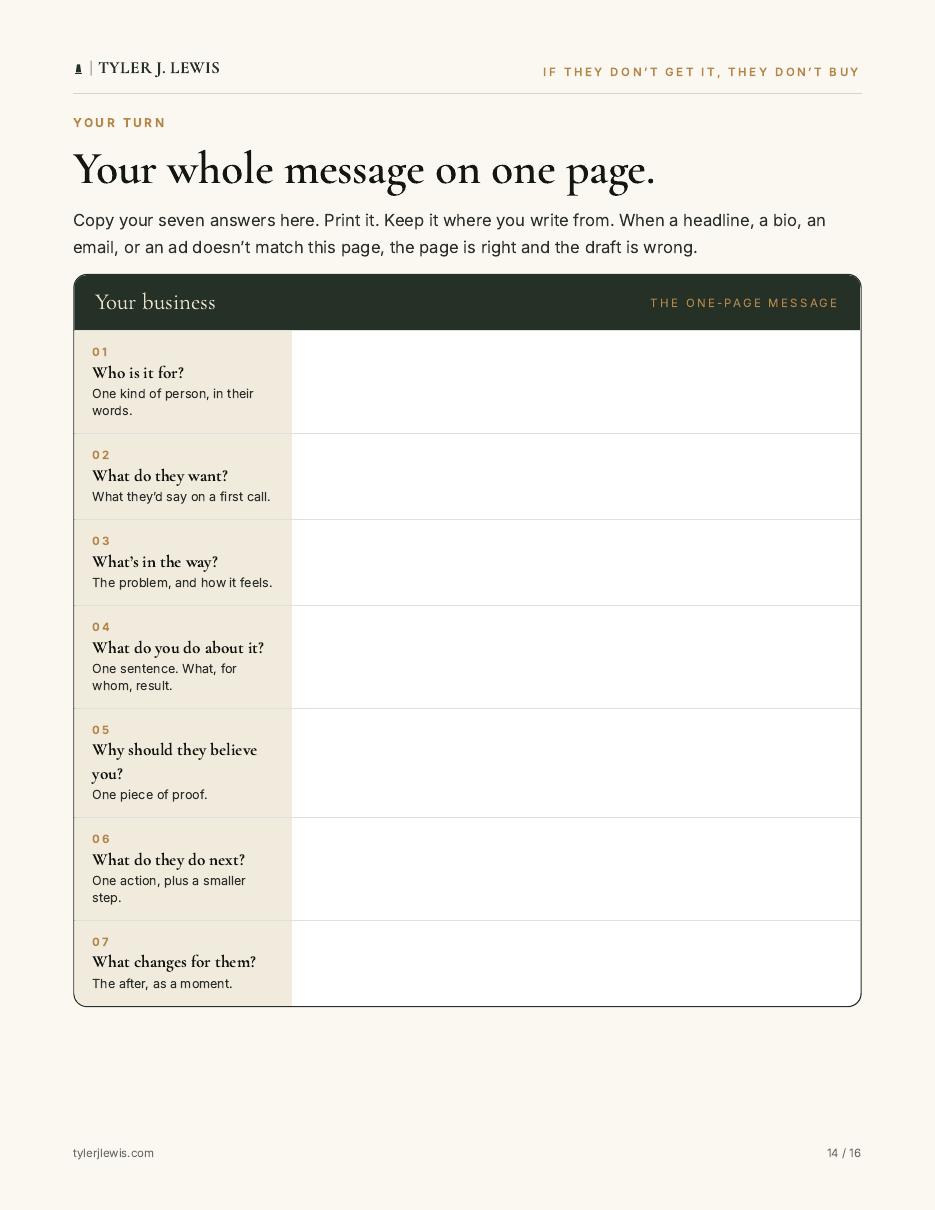
Your seven answers go onto a single sheet. You’ll see Dana’s finished sheet first, then get a blank one for yours. From then on, everything you write comes from that page: the guide shows you how the same seven answers become your homepage headline, your bio, the opening line of an email, and what you say when someone asks what you do.
Telling you to “be clear” isn’t much help. Showing you three answers to the same question, side by side, from not clear to clear, is. That’s how every question in the guide works. Dana, the bookkeeper in the examples, is made up. The financial advisor and my own story are real, and I’ll always tell you which is which.
Page 12: Question 4, the one sentence that says what you do. Dana’s three answers, each one labeled, so you can see what changes from the weak one to the clear one, and then write your own underneath.
Page 17: Dana’s finished one-page message, all seven answers on one sheet. The next page is a blank one for you. Print it, fill it in, and write everything else from it.
I wrote this for the owner who is good at the work and knows it, but has never been able to say what they do in a way that lands as well in writing as it does across a table. Here’s an honest look at who it helps and who it won’t.
No. Branding exercises tend to produce a set of values and a color palette. This produces words you can use tomorrow. It’s seven questions with honest answers, and the answers become your headline, your bio, and what you say when someone asks what you do. You don’t need a designer, and you don’t need to change your name or your logo.
No, and I want to be honest about that up front. The guide removes one specific reason people leave: they didn’t understand you. That’s a big reason, and fixing it makes everything else you do work better. But who sees your message, what you sell, your prices, and how you follow up all still matter, and no guide can fix those for you.
Yes. The real story in the guide is about a financial advisor, and financial services is about as regulated as it gets. When the guide reaches the question about proof, it includes a note on what you can use instead of client results or testimonials when your industry has rules about those things. Clear language about who you help and what they get is allowed everywhere.
Two things. I send you the guide, and I add you to my marketing lessons, which are short emails about the same kind of fixes you’ll find in the guide. You’ll get a few over the first couple of weeks, then about one a week. Every email has an unsubscribe link at the bottom, and one click stops all of it. I never sell or share your address.
Run the five-second test today, before you change anything. Answer the seven questions over the next week. Then put your one sentence at the top of your homepage and watch what happens when a stranger finally understands you the first time.
Get the free guideIt’s free. Enter your email above and the PDF opens right away.